Wake up with a full tank.
Professional Level 2 EV charger installation for homes across Williamsport, Lycoming, Clinton, Centre, Union, and Northumberland Counties — installed by a Tesla Certified electrician.
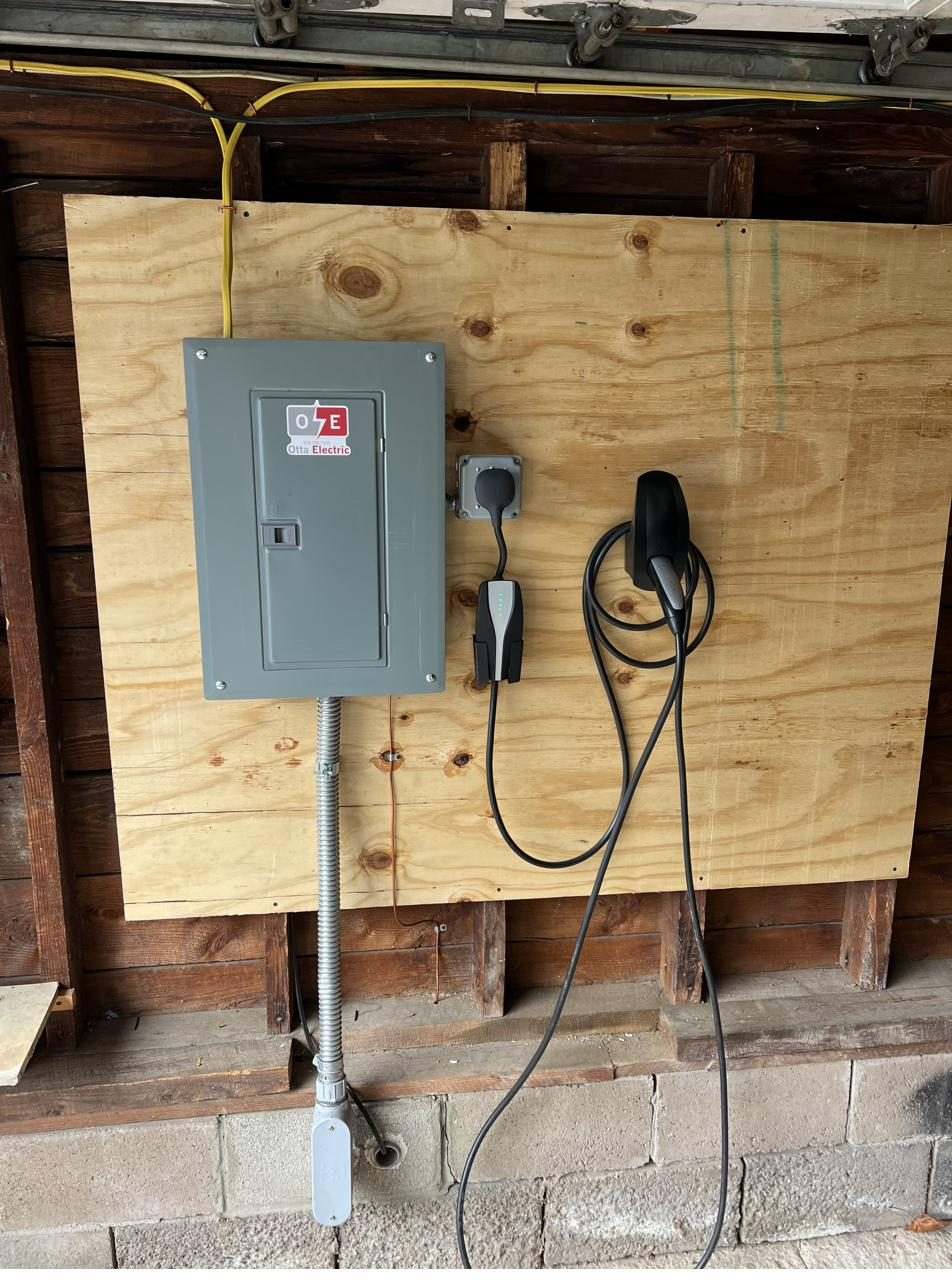
Upgrade your stock charger and wake up with full range
Your new EV came with a Level 1 charging cable that plugs into a standard wall outlet at home, but it may not be as fast as you think. According to the U.S. Department of Transportation, Level 1 charging takes 40 to 50+ hours to bring a battery-electric vehicle to 80% from empty — about 2 to 5 miles of range per hour. So what's the fix?
A dedicated Level 2 charger, running on a 240-volt circuit, cuts that time down to 4 to 10 hours for the same charge — 10 to 20 miles of range per hour. This enables you to leave your car charging overnight and wake up with a full charge, aka the full range you might need. Many EV drivers keep their Level 1 charger in the vehicle as a backup — not their main means of charging.
What you'll actually pay to charge at home
Charging costs come down to two numbers: your local electricity rate and how efficient your vehicle is. Homeowners in Williamsport and across PPL Electric's service territory — which covers most of Lycoming, Clinton, Centre, Union, and Northumberland Counties — pay residential electric rates around 16¢ per kWh all-in.
At that rate, a Tesla Model 3 — which uses about 26 kWh per 100 miles — costs roughly $0.04 per mile to drive. A comparable gas car averaging 28 miles per gallon at $4.00 per gallon costs about $0.14 per mile.
Driven 15,000 miles a year — a typical annual mileage — that's about $624 a year in electricity versus $2,143 a year in gas. That's roughly $1,500 a year in fuel savings.
| Annual cost (15,000 mi/yr) | Gas car (28 MPG @ $4.00/gal) | EV at home (16¢/kWh) |
|---|---|---|
| Cost per mile | $0.14 | $0.04 |
| Cost per month | $179 | $52 |
| Cost per year | $2,143 | $624 |
Less maintenance, comparable lifespan
2,000 vs. 18 moving parts
A gas engine has roughly 2,000 moving parts. An electric motor has about 18 — which is why EVs skip oil changes, spark plug replacements, transmission service, and exhaust repairs entirely. That difference adds up to roughly 35 to 50% less spent on maintenance over the life of the vehicle, according to Consumer Reports.
124,000 miles average lifetime
Despite having far fewer parts to maintain, EVs hold up just as well over time. A 2025 study published in Nature Energy, analyzing nearly 30 million vehicles in the UK, found that modern EVs now average 124,000 miles over their lifetime — slightly more than comparable gas vehicles.
What to consider before you switch
EVs aren't the right fit for everyone, and it's worth going in with the full picture.
Cold weather affects range
Central PA winters are no joke, and EV batteries are sensitive to cold. According to AAA testing, EVs can lose up to 41% of their rated range at 20°F with the heat running. That range loss is temporary, not permanent — and preconditioning your car while it's still plugged in can recover 10 to 20% of it. This is actually one more reason a home charger matters: warming up the battery on grid power before you unplug, rather than burning range to do it on the road.
The upfront price is higher
EVs carry a real purchase premium over comparable gas vehicles — often several thousand dollars more at the time of sale. The savings on fuel and maintenance build up over years of ownership, not on day one.
Long road trips take more planning
A gas car lets you stop for five minutes and keep going. An EV road trip means mapping charging stops ahead of time, especially in less-populated stretches of central Pennsylvania where fast chargers are still catching up to demand.
Not every home can support a charger
Renters, homes without a garage or dedicated parking, and older electrical panels can all complicate a Level 2 install. It's worth having an electrician assess your specific setup before assuming either way.
Installed by a Tesla Certified electrician
Otta Electric holds Tesla Certified Installer status — a credential that requires manufacturer-specific training on the Tesla Wall Connector and its installation standards. It's not a certification every electrician has, and it means your install is done to the standard Tesla itself sets for its hardware.
That said, you don't need to drive a Tesla to work with us. We install Level 2 chargers from the major brands homeowners ask for, and we'll help you pick the right one for your vehicle, your panel, and your budget.
As a licensed electrical contractor, we handle the entire job ourselves — load calculations, permitting, wiring, and the final install — rather than subcontracting pieces out to unlicensed labor. One team, fully accountable for the work, from the panel to the plug.
What to expect during installation
Load calculation & panel check
Before any wiring goes in, we run a load calculation against your home's electrical panel. An EV charger pulls a significant, continuous load, and depending on your panel's age and capacity, you may need an upgrade before adding one. We'll tell you upfront if that's the case.
Permit & placement
A garage is the ideal location for a Level 2 charger — it protects the unit from rain, snow, and temperature swings that shorten its lifespan over time. If a garage isn't an option, an outdoor wall-mount works too, as long as the charger is rated for weather exposure. Whether you're in Williamsport proper or one of the surrounding boroughs, we handle the permit process so you don't have to.
Install & inspection
Most home EV charger installations take 2 to 4 hours of on-site work, plus time for permitting and inspection — typically a day or two depending on your township.
A 240-volt circuit running every night, for hours, isn't forgiving of shortcuts.
A Level 2 charger runs on a dedicated 240-volt circuit, often pulling 40 amps or more for hours at a time, every night. A loose connection on a circuit like that isn't a minor issue — it's a fire risk. Beyond safety, unpermitted electrical work can void your charger's warranty, your vehicle's warranty, and in some cases complicate a homeowner's insurance claim if something goes wrong down the line.
A licensed electrician pulls the permit, sizes the circuit correctly, and signs off on an inspection — so the install is safe, it's documented, and it's covered if anything ever needs to be revisited.
Not sure which EV is right for you?
If you're still deciding on a vehicle before you're ready to talk chargers, Kelley Blue Book's electric vehicle rankings are a solid place to start comparing range, price, and reviews across current models.
Browse EV Rankings on KBB →Frequently asked questions
Yes, technically — that's what the Level 1 cable that came with your EV is for. But it's slow, often 40+ hours for a meaningful charge, which is why most owners upgrade to a dedicated Level 2 circuit for daily use.
In almost every central PA township, yes. An EV charger installation requires a new 240-volt circuit, which falls under standard electrical permitting. We pull the permit and handle the inspection as part of the job.
Maybe — it depends on your panel's age and existing capacity. We run a load calculation before any work begins so you know upfront whether your current panel can handle the added circuit or needs an upgrade first.
Most installs take 2 to 4 hours of on-site work. Add a day or two for permit approval and inspection, depending on your township's turnaround time.
Most Level 2 chargers are compatible with the majority of EVs on the road, though connector types vary by brand and vehicle. We'll confirm compatibility with your specific make and model before installing.
No. Level 2 is the charging method recommended by Tesla, ChargePoint, and most major manufacturers for daily use. It's gentler on the battery than DC fast charging and far more practical than Level 1.
Where This Comes From
- U.S. Department of Transportation — EV Charging Speeds transportation.gov
- U.S. Department of Energy — EV vs. Gas Maintenance Cost Per Mile energy.gov
- Consumer Reports — Electric Vehicle Maintenance Cost Study consumerreports.org
- AAA — Cold Weather EV Range Testing aaa.com
- PPL Electric — Residential Price to Compare Tariff, June 2026 pplelectric.com
- Nature Energy — EV Lifespan Study (2025) nature.com
- Kelley Blue Book — Electric Vehicle Rankings kbb.com